

-
Services
-
 Translation Services
Accurate and fast human-powered translations for global needs by top language experts to 80+ languages.
-
 Certified Translation
Certified translation for USCIS or other purposes done by translators certified by ATA, BDÜ, NAJIT.
-
 Localization
Tailored localization solutions for the global expansion of your content into international markets.
-
 Transcription Services
Our experts convert audio, video, or podcasts into text or subtitle, making your content accessible.
-
 MT Post-Editing
Expert post-editing services for machine-translated content that ensure fluency and excellence.
-
 DTP Service
Excellent combination of translation and DTP expertise perfectly fit for the materials intended for publication.
-
 E-learning translations
Elevate your e-learning content with expert translation services across diverse language audiences.
-
 Voice over
Bring your videos to life in any language with our professional voiceover translation services.
-
- Languages
- Industries
- Business & Commerce
- Finance
- Marketing & Advertising
- Certificates, Diplomas, Licenses
- Legal
- E-learning translations
- IT & Software
- Technical
- Personal Content
- Manufacturing & Engineering
- Medicine
- Art & Literature
- Audio & Video Script
- Prices
- Blog
- About Us
- How it works
- Testimonials
- Immigration & Visa Certified Translation Use Cases
- Certified Translation Use Cases
- Document Translation Samples
- Certificate Samples
- Discounts
- Meet Our Expert Team
- FAQ
- Free Quote
- Contact Us


Certified Translation of Immigration Documents for Visas and Residency Worldwide
Certified translations of birth, marriage and police certificates, diplomas and other immigration documents for USCIS, US consulates, IRCC, the UK Home Office, Schengen consulates and immigration offices worldwide. Each translation comes with a signed certificate of accuracy, formatted for the authority you apply to, and most single-page documents are delivered within 24 hours.


Certified Immigration Translation. 24H Delivery
Certified translations of foreign-language documents by professional translators, for visa, residence and citizenship applications in any country.
Home > Services > Certified Translation Services > ImmigrationTranslation >
What Is Certified Translation for Immigration?
A certified translation for immigration is a complete translation of a foreign-language document, signed by a qualified translator who confirms that it is accurate and that they are competent in both languages. Every immigration authority asks for this, and each adds its own rules:
- USCIS wants the translator’s certification
- IRCC wants a certified translator’s stamp or an affidavit
- The UK Home Office wants the translator’s contact details
- Some Schengen consulates want a sworn translator
Officers don’t re-translate your documents; they rely on the certificate. Missing stamps, untranslated handwriting or an incomplete certificate lead to requests for more evidence, delays or refusals. The sections below set out what each authority requires.
Immigration Translation Requirements at a Glance
| Authority / Translate into |
Who can translate | What must come with the translation |
Notarization |
| USCIS (US) / English |
Any competent translator. ATA certification isn’t required |
The translator’s signed statement of accuracy and competence |
Not required |
| NVC and US consulates (immigrant visas) / English, or the official language of the interview country |
Any competent translator |
The translator’s signed statement of accuracy and competence |
Not usually required |
| IRCC (Canada) / English or French |
A certified translator (a member of a professional translation association). Not family members, representatives or consultants |
The translator’s stamp with membership number, or an affidavit, plus a copy of the original |
Only for the affidavit |
| UK Home Office / English or Welsh |
Any professional translator |
Confirmation of accuracy, date, the translator’s full name, signature and contact details |
Not required |
| Schengen consulates /
English or the country’s official language, as the consulate states |
Varies. Some require a sworn translator | As listed in the consulate’s checklist | Varies |
| Australia (Home Affairs) / English |
In Australia, a NAATI-accredited translator. gives their details |
The translator’s NAATI number, or their full name, address, phone number and qualifications |
Not usually required |
Translation for USCIS (United States)
USCIS requires a full English translation of every foreign-language document. It must come with the translator’s certification that the translation is complete and accurate and that they are competent to translate from the foreign language into English (8 CFR 103.2(b)(3)). Notarization is not required, and you can submit copies of your documents with the translations unless USCIS asks for originals. For green card, naturalization and family petitions, our USCIS certified translation page lists the documents each form needs (I-130, I-485, N-400, I-751, K-1 and more).
Translation for NVC and US Consulates
For immigrant visas processed by the National Visa Center (NVC) and US embassies or consulates, every civil document that is not in English, or in the official language of the country where you’ll be interviewed, needs a certified translation. The translation must include a statement signed by the translator that it is accurate and that the translator is competent to translate. You upload scans to the Consular Electronic Application Center (CEAC), then bring the original or certified copies of your documents, with the translations, to the interview.
Translation for IRCC (Canada)
IRCC accepts documents in English or French only. Each translation must be stamped by a certified translator: a member in good standing of a professional translation association in Canada or abroad, whose stamp shows their membership number. If a certified translator isn’t available, the person who translated the document must swear an affidavit before a notary public or commissioner. Include a copy of the original document. IRCC doesn’t accept translations by the applicant’s family members, representatives or consultants. See our ATIO and STIBC certificate samples.
Translation for UK Visas (Home Office)
If a document is not in English or Welsh, the Home Office needs a full translation that it can verify independently. Each translation must contain:
- The translator’s confirmation that it is an accurate translation of the original document
- The date of translation
- The translator’s full name and signature
- The translator’s contact details
There is no official register of translators in the UK, and notarization is not required for visa applications.
Translation for Schengen Visas
Each Schengen country sets its own rules, published in the document checklist of its consulate or visa application centre (such as VFS Global, TLScontact or BLS International). Many consulates accept documents in English. Others ask for a translation into their official language, and some require a sworn translator registered in that country. Check the checklist for the country you’re applying to, and tell us the consulate when you order so we can match its format.
Translation for Australian Visas (Home Affairs)
Australia’s Department of Home Affairs needs English translations of all non-English documents. If the translation is done in Australia, the translator must include their NAATI practitioner number. If it is done outside Australia, the translation must include the translator’s full name, address, phone number and qualifications.
.png)
.png)
.png)

.png)
What Our Clients Say
.png)
Local Guide
18 reviews
"I am impresed about the quick and professional manner TheWordPoint display their work, my documents translated. It is extremely accurate and precise. Besides, about the price , I consider more than fair but not expensive at all. I definetely will keep using your services and recommending to anybody. For security reasons I can't add a copy of the documentation, but I chosen them due they are very professionals about legal and serious documents like USCIS (immigration), they translate for them, point extremely important due this institutions regulations. You can be confident the translation will be more than accepted anywhere. This is my second service with them, and I already was aproved by the USCIS. Confirmed. Thank you very much."
Immigration Documents We Translate
Immigration documents mix legal terms, local record formats, stamps and handwritten notes, from a birth certificate to a CV for a work visa. They need a professional translator who knows how immigration officers read them. Don’t translate your own documents: most authorities expect an independent translator, and IRCC refuses translations by family members or representatives. See our visa application use case and employment relocation use case for how translations are prepared for embassies, consulates and employers.
Requirements vary from country to country, but after years of providing document translation services for USCIS, IRCC, the UK Home Office and consulates worldwide, we know which supporting documents immigration applicants most often need translated:
- Birth certificates. Required for almost every family, residence and citizenship application. They confirm the identity and citizenship of the applicant and family members. All text, official stamps, seals, registrar signatures and handwritten notes must be translated.
- Marriage certificates. Required for spouse and partner visas (such as the US I-130 and K-1, the UK spouse visa and Canadian spousal sponsorship), adjustment of status and naturalization. This includes religious and civil marriage records, domestic partnership certificates and foreign marriage registrations.
- Divorce decrees and dissolution records. Required when the applicant or the sponsor was married before. Every page is translated, including the final judgment wording, the parties’ names and the dates.
- Police clearances and criminal records. Required for US green cards, Canadian and Australian permanent residence, many work visas and naturalization. All offense descriptions, case outcomes and official stamps are translated.
- Academic transcripts and diplomas. Required for student visas, skilled-work visas such as the US H-1B, US EB-2 NIW petitions and Canadian Express Entry credential assessments. This covers high school and university documents from every country.
- Bank statements, employment letters and tax records. Required to prove funds and employment for visitor, student, work and family visas, such as the US I-864 Affidavit of Support, the UK financial requirement or proof of means for a Schengen visa.
- Passports, national ID cards and travel documents. Required for identity checks. We translate the data pages, visa pages and any entry or exit stamps the authority asks for.
- Vaccination and immunization records. Required for the US green card medical exam (I-485) and by some other countries for residence applications.
- Adoption papers. Required when a child is included in an immigration application. We translate all adoption documents, court orders and agency records. Some authorities require a notarized translation of adoption records, so confirm the requirement before you order.
- Death certificates. Required for widow(er) petitions, inheritance-related immigration matters and some family sponsorship categories.
Need a document translation for immigration process? We are here 24/7 to help
Request a Translation
 Reviews
Certified Immigration Translation Prices
Certified immigration translations are priced per page, and include professional human translation, accurate formatting, and a signed certificate of accuracy. Pricing depends on language, document type, and urgency. Volume discounts apply when ordering multiple documents together, and TheWordPoint provides a fixed quote before the translation begins.
Standard delivery: 24 hours for most single-page documents. Same-day delivery adds 25–50%.
Package tip: most visa and residence applications need 3–6 documents translated. Ordering them together gives you a volume discount and keeps names and formatting consistent across the package.
|
Type of Documents |
Price per page in a one-page document |
Price per page in a 2-page document |
Price per page in a 3-page document |
| Birth Certificate |
$24.75 |
$22.87 |
$20.21 |
|
Academic Transcript |
$28.90 |
$26.38 |
$24.41 |
|
High School Diploma |
$24.75 |
$22.87 |
$20.21 |
|
Marriage Certificate |
$25.80 |
$23.71 |
$21.94 |
|
Immunization Record, Vaccination Records |
$25.80 |
$23.71 |
$21.94 |
|
Divorce Certificate |
$26.90 |
$24.75 |
$22.80 |
|
Driver's License, ID, Passport |
$18.75 |
$17.85 |
$16.50 |
|
Police Clearance, Criminal Records |
$24.75 |
$22.87 |
$20.21 |
| Scholarship applications | $28.90 | $26.38 | $24.41 |
| Bachelor's, Master's, and Doctorate degrees | $26.90 | $24.75 | $22.80 |
| Certificates of completion | $25.80 | $23.71 | $21.94 |
| Bank Statements | $18.90 | $17.25 | $16.10 |
Our Translators Are Certified By:
Why Do Immigration Offices Reject Translations?
Officers compare the translation with the original. If something is missing, USCIS issues a Request for Evidence (usually with 87 days to respond), and other authorities ask for new documents or refuse the application. The most common translation problems are:
- Missing certification statement — the certificate of accuracy must include the translator's full name, contact information, date, and signed attestation. Our translations include this by default.
- Untranslated stamps, seals, or handwritten text — immigration offices expect every element of the original document to be translated, not just printed text. We translate all stamps, official seal labels, and handwritten annotations.
- Formatting that does not correspond to the original — Officers compare the translation against the original document. Our translations mirror the structure and layout of the source document.
- Translation by the applicant or a relative. IRCC refuses these outright, and other authorities expect an independent translator.
TheWordPoint's two-stage review process — primary translation followed by independent review before certification — is specifically designed to prevent all of these issues. If USCIS or another immigration office returns your translation for a reason related to our work, we revise it at no cost or refund you.
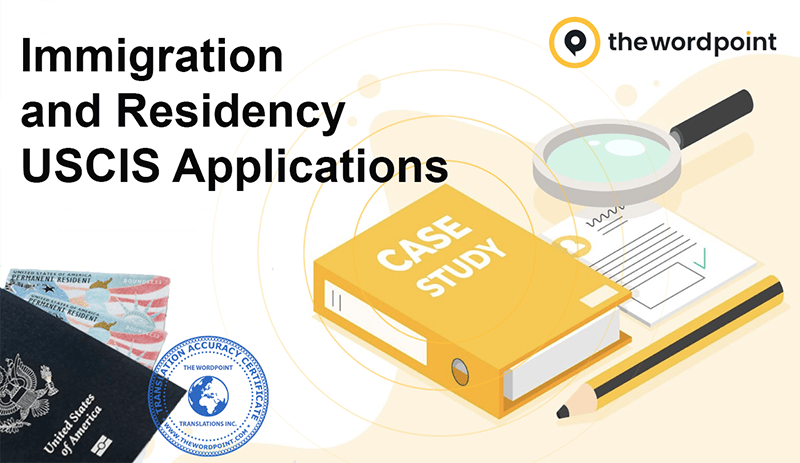
Immigration and Residency Applications Document Translation Case Study
Immigration and residency applications through USCIS and other immigration authorities require precise certified translations of personal documents, civil records, and supporting materials. Each document must meet specific certification standards, and even minor errors in translation or formatting can result in Requests for Evidence (RFEs), processing delays, or application rejections. Our case study and knowledge base provide practical guidance drawn from thousands of successful immigration translation projects, clarifying exactly what USCIS and immigration offices require. Learn which documents need translation, what certification format is accepted, how to structure the Certificate of Accuracy, and common mistakes to avoid. Whether you're applying for a green card, family-based visa, adjustment of status, or permanent residency, these resources help ensure translations that immigration offices accept the first time.
.
|
Case Study |
Certified Translation for Immigration and Residency Applications |
|
Authored by |
Christakis Christodoulou |
|
Date |
January 04, 2026 |
|
Translation Accuracy Certificate Type |
USCIS |
Context and backgroundImmigration and residency applications are document-driven processes. Whether an individual is applying for a family-based visa, employment authorization, permanent residency, or adjustment of status, immigration authorities rely heavily on written records to establish identity, relationships, eligibility, and legal history. Birth certificates, marriage records, divorce decrees, police clearances, academic diplomas, and court decisions all become part of the official file. In most jurisdictions, including the United States, immigration authorities require these documents to be submitted in English when the original is in another language. A certified translation is a legal instrument that allows an immigration officer to assess the application without ambiguity. Any discrepancy between the source document and the translation can trigger delays, Requests for Evidence, or outright rejection. Applicants often encounter this requirement late in the process, after forms are completed, and deadlines are approaching, which raises the stakes considerably. |
|
ChallengeThe primary challenge lies in balancing accuracy, compliance, and timing under pressure. Applicants frequently assume that fluency in English is sufficient to translate their own documents or rely on automated tools. Others submit partial translations, omit stamps or handwritten notes, or misunderstand what “certified” actually means. These missteps are rarely malicious, but immigration authorities treat them strictly. Additional challenges include: • Complex document formats containing seals, annotations, or marginal notes A single translation error, even a minor one, can introduce doubt into an otherwise strong application. |
|
Approach & SolutionThe solution begins with clarity. Before any translation work starts, documents are reviewed to determine scope, format, and specific immigration authority requirements. This includes confirming whether the submission is for USCIS, a consulate, or a foreign immigration office, as requirements can differ slightly. Each document is translated in full, word for word, including all stamps, seals, headers, footnotes, and handwritten content. Formatting is preserved where possible to ensure the translated version mirrors the original document, allowing officers to cross-reference easily. Certified translators with experience in immigration documentation handle the work. Their role extends beyond linguistic conversion; they understand how civil and legal records are structured in different countries and how immigration officers read them. Every translation is accompanied by a signed Certificate of Accuracy stating that the translation is complete and accurate and that the translator is competent in both languages. Quality control is deliberately conservative. Translations are reviewed line by line to ensure names, dates, and legal terminology are consistent across all documents in the application packet. This reduces the risk of internal discrepancies that can trigger follow-up inquiries. |
|
ResultsApplications supported by properly certified translations moved through the review process without translation-related objections. Clients avoided Requests for Evidence tied to document quality, which are among the most common causes of immigration delays. In cases involving multiple documents from different jurisdictions, consistency across translations helped present a coherent narrative of the applicant’s background. Immigration officers were able to assess eligibility efficiently, without needing clarification or supplemental submissions. Perhaps most importantly, applicants gained confidence. Knowing that their documents met formal requirements allowed them to focus on the broader application process rather than worrying about technical compliance. |
|
Advice SummaryCertified translation is not an area where shortcuts pay off. For immigration and residency applications, the safest approach is to treat translations as legal documents, not language exercises. Key takeaways for future applicants include: • Confirm certified translation requirements early in the process When immigration outcomes depend on paperwork, precision becomes protection. Investing in proper certified translation is often the simplest way to remove unnecessary risk from an already demanding process. |
|
How Immigration Document Translation Works
Immigration translations follow stricter rules than everyday translation: every stamp, seal and handwritten note is translated, names match your passport, and the certificate meets the receiving authority’s format. For US applications, our USCIS certified translation page explains the exact requirements. Here is how an order works:
- Upload your document. Submit a clear scan or photo through our secure order form. All file formats accepted. Stamps, seals, and handwritten content must be fully visible in the scan — immigration offices expect these to be translated.
- Fixed price and turnaround confirmed. We review your document and confirm an exact, fixed price and delivery time within minutes. No hidden fees. Rush options confirmed at this stage if needed.
- Immigration specialist translator assigned. Your document is matched to a certified translator with experience in immigration documents and your specific language pair. All translators hold ATA, BDÜ, NAJIT, or equivalent certification.
- Complete translation including all document elements. The translator produces a full translation of all text, stamps, seals, and handwritten annotations. A second independent reviewer checks accuracy, completeness and compliance with the authority’s requirements.
- Certified delivery. Your certified translation is delivered as a PDF within 24 hours. The signed certificate of accuracy — formatted for the authority you name (USCIS, NVC, IRCC, the Home Office or a consulate) — is attached.
Meet Our Customers













What Languages We Translate for Immigration
| → Spanish | → Portuguese | → Burmese | → Hindi | → Urdu |
| → Chinese | → Ukrainian | → Croatian | → Punjabi | → French |
| → Vietnamese | → Korean | → Danish | → Somali | → Farsi |
| → Arabic | → Bulgarian | → Estonian | → Thai | → Japanese |
Reviewed and updated on October 11, 2026, by
Christakis Christodoulou,
Managing Director
Head of the Certified Translation Department
Frequently Asked Questions
Can I translate my own immigration documents?
No. Immigration offices expect an independent, qualified translator. IRCC refuses translations by an applicant’s family members, representatives or consultants, and USCIS needs a translator who certifies their competence. Machine translation such as Google Translate is not accepted.
How much does certified immigration translation cost?
From $18.75 for a one-page passport or ID and $24.75 for a one-page birth certificate. Per-page prices are lower for 2- and 3-page documents (from $16.50 per page), and orders of several documents get a volume discount. You get a fixed quote before work begins.
How long does it take?
Most single-page documents are delivered within 24 hours, and larger orders take 24–48 hours. Same-day delivery is available.
Do I need to send the original documents?
No. Upload clear scans or photos. USCIS accepts copies with the translations unless it asks for originals. For US immigrant visa interviews and some consulates, you bring the originals or certified copies yourself.
Which documents need translation for immigration?
Any document not in the authority’s language. Usually that means birth, marriage and divorce certificates, police certificates, diplomas and transcripts, passports and IDs, bank statements and employment letters.
Do immigration translations need to be notarized?
Not for USCIS or UK visas. IRCC needs a sworn affidavit only when the translator isn’t certified. Some courts, consulates and foreign authorities do ask for notarization, and we arrange it on request.
Do you translate documents for Canadian immigration (IRCC)?
Yes. We provide translations stamped by a certified translator with their membership number, as IRCC requires. See our ATIO and STIBC certificate samples.
Do you translate documents for UK visas?
Yes. Each translation includes the details the Home Office requires: confirmation of accuracy, the date, the translator’s full name and signature, and contact details.
Do you translate for Schengen visa applications?
Yes, into English and other EU languages. If the consulate requires a sworn translator in its country, tell us the country when you order and we’ll confirm the format we can provide.
What happens if my translation is rejected?
USCIS issues a Request for Evidence, and other offices ask for corrected documents. If the problem relates to our translation, we revise it at no cost or refund you.
Can’t find an answer to your questions? Feel free to check our complete FAQ page, or contact us at [email protected]
Are you ready to start?
Translate Now
Our Support is available round the clock to make sure that the working process is smooth and comfortable.