

-
Services
-
 Translation Services
Accurate and fast human-powered translations for global needs by top language experts to 80+ languages.
Translation Services
Accurate and fast human-powered translations for global needs by top language experts to 80+ languages. -
 Certified Translation
Certified translation for USCIS or other purposes done by translators certified by ATA, BDÜ, NAJIT.
Certified Translation
Certified translation for USCIS or other purposes done by translators certified by ATA, BDÜ, NAJIT. -
 Localization
Tailored localization solutions for the global expansion of your content into international markets.
Localization
Tailored localization solutions for the global expansion of your content into international markets. -
 Transcription Services
Our experts convert audio, video, or podcasts into text or subtitle, making your content accessible.
Transcription Services
Our experts convert audio, video, or podcasts into text or subtitle, making your content accessible. -
 MT Post-Editing
Expert post-editing services for machine-translated content that ensure fluency and excellence.
MT Post-Editing
Expert post-editing services for machine-translated content that ensure fluency and excellence. -
 DTP Service
Excellent combination of translation and DTP expertise perfectly fit for the materials intended for publication.
DTP Service
Excellent combination of translation and DTP expertise perfectly fit for the materials intended for publication. -
 E-learning translations
Elevate your e-learning content with expert translation services across diverse language audiences.
E-learning translations
Elevate your e-learning content with expert translation services across diverse language audiences. -
 Voice over
Bring your videos to life in any language with our professional voiceover translation services.
Voice over
Bring your videos to life in any language with our professional voiceover translation services.
-
- Languages
- Industries
- Business & Commerce
- Finance
- Marketing & Advertising
- Certificates, Diplomas, Licenses
- Legal
- E-learning translations
- IT & Software
- Technical
- Personal Content
- Manufacturing & Engineering
- Medicine
- Art & Literature
- Audio & Video Script
- Prices
- Blog
- About Us
- How it works
- Testimonials
- Immigration & Visa Certified Translation Use Cases
- Certified Translation Use Cases
- Document Translation Samples
- Certificate Samples
- Discounts
- Meet Our Expert Team
- FAQ
- Free Quote
- Contact Us


Employee Handbook Translation Case Study
Learn how TheWordPoint localized employee handbooks, helping HR teams stay compliant while keeping policies clear and usable.


From Challenge to Solution: Translation Case Studies for Human Resources
Discover how to translate HR documents for international teams: from employee manuals to policies and training materials. Our case studies provide practical insights into quality, compliance, and scalable efficiency.
HR Documentation for Global Teams: Real-World Localization Case Study
At TheWordPoint, our HR-focused case studies explore how language solutions shape the way international businesses manage their people force. They look beyond translation as a technical task and examine how employee handbooks, internal policies, training manuals, and workplace guides function in real corporate environments. Each case highlights the moment when standardized HR documentation meets local labor laws, cultural expectations, and daily employee experience.
These studies show how carefully localized HR materials help businesses reduce compliance risk, improve clarity, and strengthen trust between management and international teams. They also illustrate why HR translation often requires more than linguistic accuracy, calling for contextual judgment and legal awareness. For companies building or expanding global workforces, the cases offer insight into how consistent policies can coexist with local adaptation.
.
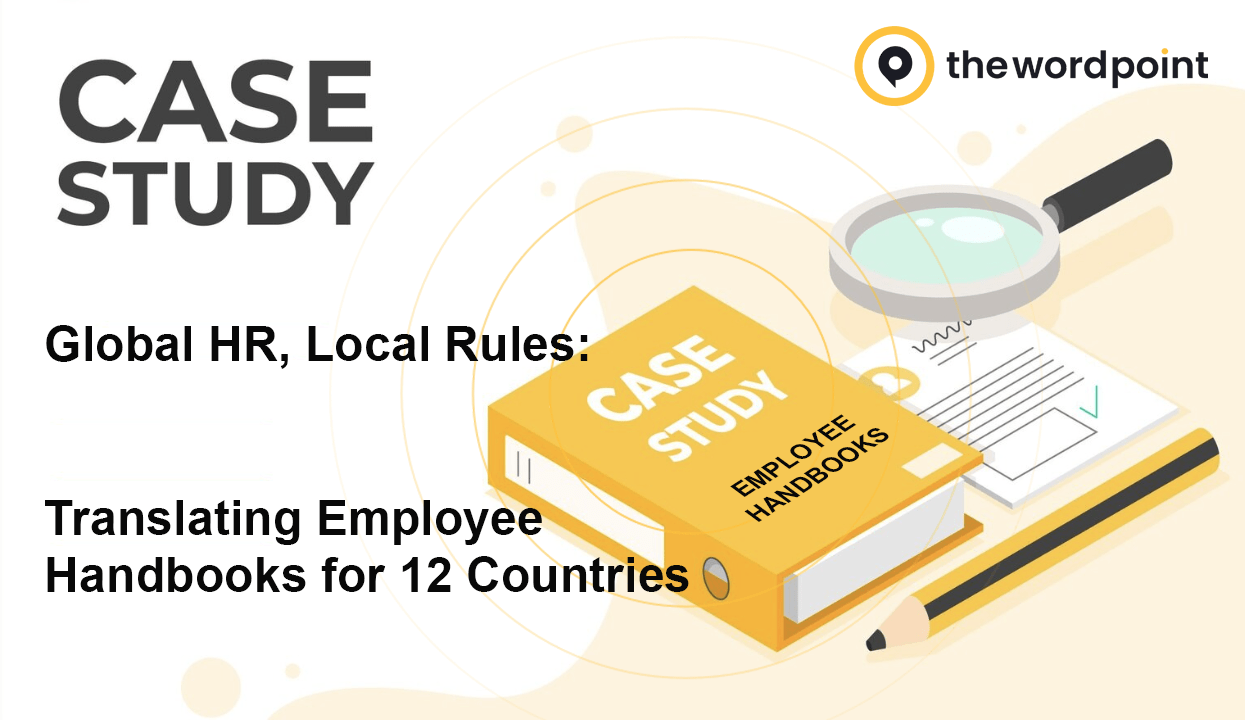
Case Study |
Global HR, Local Rules: Translating Employee Handbooks for 12 Countries |
|
Authored by |
|
|
Date |
December 19, 2025 |
|
Industry |
Corporate Services / Human Resources |
Context and backgroundThe client was a multinational organization with operations spanning Europe, North America, and Asia-Pacific. Its workforce had grown rapidly through acquisitions and regional expansion, yet its core HR documentation had remained largely unchanged. The employee handbook, originally written for domestic use, had been translated informally into a handful of languages over the years, often without legal or cultural review. As regional offices expanded, local HR managers began raising concerns. Policies written clearly in English were interpreted differently abroad, sometimes contradicting local labor law or clashing with cultural expectations around working hours, leave, and disciplinary procedures. What had once been a practical reference document was becoming a source of confusion and, in some cases, risk. The company decided to address the issue systematically by creating fully localized employee handbooks for 12 countries, each aligned with local legal frameworks while remaining consistent with corporate policy |
|
Challenge
Several obstacles emerged early in the project: • Labor laws varied significantly across target countries, requiring precise phrasing • Direct translation risked introducing statements that were non-compliant or unenforceable • Terminology around benefits, leave, and disciplinary action lacked one-to-one equivalents • HR policies had to remain consistent globally while allowing local flexibility • Regional HR teams needed to trust and use the final documents confidently The company quickly realized that a traditional translation-only approach would not be sufficient to solve the problem. What was required was controlled adaptation, guided by both linguistic and legal understanding. |
|
Approach & SolutionThe project was structured as a localization initiative rather than a translation task. We began by mapping the handbook content into categories: globally fixed policies, regionally adjustable sections, and country-specific legal references. This allowed us to define where language could remain consistent and where adaptation was necessary. Each target market was assigned a linguist with proven HR and legal translation experience. These linguists worked in close coordination with regional HR consultants who provided insight into local labor regulations and workplace norms. This collaboration ensured that the translated text reflected not only legal compliance but also how policies are typically communicated and understood in each country. From a technology perspective, we implemented a CAT tool environment with controlled terminology assets. Key corporate terms were locked to ensure consistency in all languages, while locally sensitive terminology was validated market by market. Translation memory ensured that shared policy sections remained aligned with all handbooks, reducing future update effort. Review cycles were intentionally collaborative rather than hierarchical. Drafts were reviewed jointly by corporate HR and local representatives, allowing practical feedback to shape final wording. The goal was not legal perfection alone, but usability. |
|
ResultsAll 12 localized handbooks were adopted by regional HR teams without resistance, a critical indicator of success. Local managers reported improved clarity when communicating policies to employees, particularly around leave entitlements, workplace conduct, and grievance procedures. Compliance-related concerns raised prior to the project were resolved, and no further legal clarification requests were triggered by handbook language in the following review cycle. Internally, the company gained a structured, scalable framework for future HR documentation updates, supported by translation memory and standardized terminology. Perhaps most importantly, the handbooks began to function as intended, not as legal artifacts, but as practical reference documents that employees and managers actually used. |
|
Conclusion & Lesson LearnedEmployee handbook translation service demands more than accuracy. They require careful localization grounded in legal context and cultural understanding. The key lessons are clear: • Treat HR documentation as a compliance-sensitive asset, not generic content • Involve local expertise early to avoid retroactive corrections • Separate globally fixed policies from locally adaptable language • Use translation technology to maintain consistency, not to oversimplify complexity |
|
Important Business Queries Covered In The Case Study
| Translation service for HR materials and employee handbooks | Best way to translate employee handbooks for global teams |
| Professional HR document translation services | Translation services for company policies and procedures |
| How to translate internal HR documents accurately | Employee contract translation services for multinational companies |
| Certified translation for employment contracts | How to translate company policies for international employees |
| Professional translation for labor and employment documents | Best translation provider for HR compliance documents |
Get a Free Quote or Learn About Solutions for Your Employee Manual Translation Project
Contact Account Manager

Employee Handbook Translation Services Rates
|
Language Pair |
Human Translation |
Machine Translation Post-editing |
|
$0.10 |
$0.07 |
|
|
$0.11 |
$0.08 |
|
|
$0.11 |
$0.08 |
|
|
$0.11 |
$0.07 |
|
|
$0.12 |
$0.08 |
|
|
$0.13 |
$0.09 |
|
|
$0.10 |
$0.07 |
|
|
$0.12 |
$0.08 |
|
|
Spanish to English (US) |
$0.10 |
$0.07 |
|
French (Canadian) to English (US) |
$0.11 |
$0.08 |
See all translation prices
Money-Back Guarantee
Reviewed and updated on October 8, 2026, by
Christakis Christodoulou,
Managing Director
Head of the Certified Translation Department

.png)
.png)
What They Say About Us
.png)
2 reviews
"I've used TheWordPoint for a number of translation projects for a legal information website and always been very happy with them. They are easy to work with and do an excellent job."
Meet Our Customers













FAQ
What's the difference between translating and localizing an employee handbook?
Translation converts text from one language to another. Localization adapts content to function properly within a specific legal, cultural, and operational context. For employee handbooks, localization means adjusting policy language to comply with local labor laws, using terminology that matches regional HR practices, and ensuring the tone aligns with local workplace communication norms while maintaining consistency with global corporate policy.
Who should be involved in localizing HR documentation?
Successful HR localization requires a collaborative team: experienced translators with HR and legal translation backgrounds, local HR consultants who understand regional labor regulations and workplace norms, corporate HR representatives who can clarify policy intent, and legal reviewers for compliance verification. It prevents costly retroactive corrections and ensures the final handbooks are actually trusted and used by regional teams.
What are the biggest risks of poorly translated HR documents?
The risks are substantial: legal non-compliance leading to regulatory penalties, unenforceable policies that create liability during disputes, employee confusion resulting in policy violations, damaged trust between management and staff, increased HR support burden from clarification requests, and potential discrimination claims if policies are inconsistently applied due to translation errors.
How much does professional HR document localization cost compared to basic translation?
Professional HR localization typically costs 30-50% more than basic translation due to specialized expertise, legal review, collaborative workflows, and quality assurance processes. However, the cost of getting it wrong (legal penalties, employee relations issues, rework expenses) far exceeds this investment.
Do all sections of an employee handbook require the same level of localization?
No. Content falls into different categories requiring different treatment. Company mission, values, and organizational structure typically need minimal adaptation beyond translation. Policies around working hours, leave entitlements, and disciplinary procedures require significant localization to match local laws and norms. Legal disclaimers and compliance statements often need complete rewriting by local legal experts.
Can machine translation be used for employee handbooks?
Machine translation is not always appropriate for employee handbooks due to compliance risk, terminology complexity, and the need for cultural adaptation, and requires 100% human oversight. HR documents carry legal weight, and errors can create liability, not just confusion. The nuanced language around rights, obligations, and procedures requires human judgment that understands both legal implications and cultural context. While translation memory (which stores human-translated content) improves efficiency for updates, the initial localization must be performed by qualified human experts, as demonstrated throughout this case study.
What makes an employee handbook localization project successful?
Success is measured by adoption and usability, not just linguistic accuracy. In this case study, success indicators included: regional HR teams adopting handbooks without resistance, improved clarity in policy communication, resolution of compliance concerns, no legal clarification requests triggered by handbook language, creation of a scalable framework for future updates, and most importantly, employees and managers actually using the handbooks as intended. The key was treating the project as localization requiring legal and cultural expertise, not just translation requiring linguistic skill.
Can’t find an answer to your questions? Feel free to check our complete FAQ page, or contact us at [email protected]
Are you ready to start?
Translate Now
Our Support is available round the clock to make sure that the working process is smooth and comfortable.