

-
Services
-
 Translation Services
Accurate and fast human-powered translations for global needs by top language experts to 80+ languages.
Translation Services
Accurate and fast human-powered translations for global needs by top language experts to 80+ languages. -
 Certified Translation
Certified translation for USCIS or other purposes done by translators certified by ATA, BDÜ, NAJIT.
Certified Translation
Certified translation for USCIS or other purposes done by translators certified by ATA, BDÜ, NAJIT. -
 Localization
Tailored localization solutions for the global expansion of your content into international markets.
Localization
Tailored localization solutions for the global expansion of your content into international markets. -
 Transcription Services
Our experts convert audio, video, or podcasts into text or subtitle, making your content accessible.
Transcription Services
Our experts convert audio, video, or podcasts into text or subtitle, making your content accessible. -
 MT Post-Editing
Expert post-editing services for machine-translated content that ensure fluency and excellence.
MT Post-Editing
Expert post-editing services for machine-translated content that ensure fluency and excellence. -
 DTP Service
Excellent combination of translation and DTP expertise perfectly fit for the materials intended for publication.
DTP Service
Excellent combination of translation and DTP expertise perfectly fit for the materials intended for publication. -
 E-learning translations
Elevate your e-learning content with expert translation services across diverse language audiences.
E-learning translations
Elevate your e-learning content with expert translation services across diverse language audiences. -
 Voice over
Bring your videos to life in any language with our professional voiceover translation services.
Voice over
Bring your videos to life in any language with our professional voiceover translation services.
-
- Languages
- Industries
- Business & Commerce
- Finance
- Marketing & Advertising
- Certificates, Diplomas, Licenses
- Legal
- E-learning translations
- IT & Software
- Technical
- Personal Content
- Manufacturing & Engineering
- Medicine
- Art & Literature
- Audio & Video Script
- Prices
- Blog
- About Us
- How it works
- Testimonials
- Immigration & Visa Certified Translation Use Cases
- Document Translation Samples
- Certificate Samples
- Discounts
- Meet Our Expert Team
- FAQ
- Free Quote
- Contact Us


Certified Translation Use Cases
Discover real-world certified translation examples and expert guidance from our knowledge base, trusted by thousands of customers to make a certified translation smooth and straightforward.


From Challenge to Solution: Certified Translation Cases Studies
Our use cases and knowledge base provide practical insights into the certified translation requirements of immigration offices, government authorities, educational institutions, courts, and other official bodies.
Home > Services > Certified Translation Services > Use Cases >
Navigate Certified Translation Requirements with Confidence: Use Cases and Insights in 2026
Submitting documents to immigration offices, universities, courts, or government agencies without a proper certified translation service can result in delays, rejections, or costly resubmissions. Our use cases and knowledge base remove the guesswork by providing clear, practical guidance on certified translation requirements across different institutions and purposes. Explore real examples of what's required for visa applications, academic admissions, legal proceedings, citizenship applications, and more. These resources are built from thousands of actual translation projects, helping you get it right the first time.
|
USE CASE: |
AUTHOR: |
DATE: |
|
|
January 04, 2026 |
|||
|
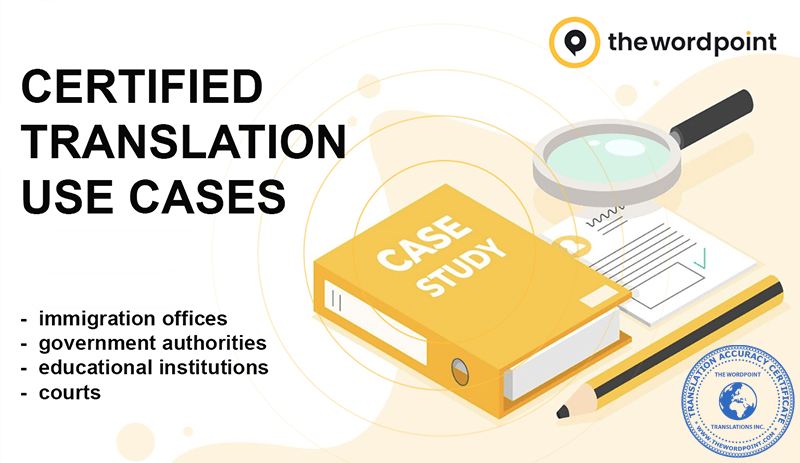
Certified translations of birth certificates, marriage records, police clearances, and other personal documents are required by USCIS and immigration authorities to verify identity, family relationships, and eligibility for green cards or residency permits. |
|||
|
USE CASE: |
AUTHOR: |
DATE: |
|
|
January 05, 2026 |
|||
|
Colleges, Universities, and credential evaluation services demand certified translations of diplomas, transcripts, and recommendation letters to accurately assess foreign academic qualifications for admissions or degree equivalency. |
|||

|
USE CASE: |
AUTHOR: |
DATE: |
|
|
January 05, 2026 |
|||
|
Employers, licensing boards, and professional associations often require certified translations of degrees, certifications, and work experience documents to confirm qualifications for job offers or professional licenses. |
|||

|
USE CASE: |
AUTHOR: |
DATE: |
|
|
January 06, 2026 |
|||
|
During naturalization, USCIS needs certified translations of foreign documents like divorce decrees or name change records to ensure all background information is accurately reviewed for citizenship eligibility. |
|||
|
USE CASE: |
AUTHOR: |
DATE: |
|
|
January 06, 2026 |
|||
|
Certified translations of foreign financial statements, tax returns, or property documents may be needed for IRS filings, social security claims, or other government programs requiring proof of overseas income or status. |
|||

|
USE CASE: |
AUTHOR: |
DATE: |
|
|
January 07, 2026 |
|||
|
Embassies and consulates require certified translations of supporting documents such as bank statements, invitation letters, or academic records to verify the applicant's purpose, ties, and eligibility for various visa types. |
|||
|
USE CASE: |
AUTHOR: |
DATE: |
|
|
January 07, 2026 |
|||
|
Courts, attorneys, and legal proceedings accept certified translations of contracts, wills, powers of attorney, or foreign judgments to ensure accurate interpretation in lawsuits, adoptions, or inheritance cases, and official validity in contracts and court filings. |
|||

|
USE CASE: |
AUTHOR: |
DATE: |
|
|
January 08, 2026 |
|||
|
Healthcare providers, insurance companies, or disability claims may request certified translations of medical records, prescriptions, or treatment histories to facilitate care coordination or benefit approvals across language barriers. |
|||
|
USE CASE: |
AUTHOR: |
DATE: |
|
|
July 11, 2026 |
|||
|
Explore which U.S. authorities, institutions, and organizations accept certified translations and Translation Certificates of Accuracy in digital format, and which still require a physical original — so the right format gets ordered the first time. |
|||

|
USE CASE: |
AUTHOR: |
DATE: |
|
|
July 11, 2026 |
|||
|
Certified translations of foreign diplomas, transcripts, and professional licenses for nursing, medical, engineering, and other credential evaluations. Learn how certified translation of foreign academic and licensing records supports first-pass acceptance with CGFNS/TruMerit, ECFMG, WES, ECE, and state licensing boards. |
|||


.png)
.png)
.png)
What Our Clients Say About Us
.png)
1 reviews
"10/10 highly recommend. What separates this service from other services is that the communication is quick and highly reliable. My custom needs were met perfectly along with how fast the translation was done and how correct it was."
How Institutions Treat Translated Documents
What unites immigration, education, and government use cases is not the type of document, but the way institutions treat translated material. They assume that a certified translation is complete, accurate, and reliable. They do not cross-check it against the original language. If an error exists, it becomes part of the official record. This is why certified translation is fundamentally different from general translation, and why shortcuts so often backfire.
The value of studying use cases lies in seeing patterns that are otherwise invisible. Applicants learn that USCIS does not require notarization, but does require a signed certificate of accuracy. They learn that academic institutions rarely demand ATA certification, but will reject uncertified translations outright. They learn that police clearance and criminal records must be translated in full, including boilerplate text and legal disclaimers, even if they appear repetitive or irrelevant.
Use cases also clarify where technology fits, and where it does not. Translation memory tools, formatting software, and quality assurance systems help ensure consistency and efficiency. They reduce human error and speed up delivery. But use cases consistently show that certified translation cannot rely on AI alone. Automated systems do not understand legal thresholds, evidentiary standards, or institutional expectations. Human oversight remains essential, not because machines are inadequate linguistically, but because compliance is contextual.
Certified Translation Knowledgebase 2026 |
|
|
What is Certified Translation? |
A certified translation is a full, accurate word-for-word translation that comes with a signed statement (known as Certificates of Accuracy) from the translator or translation company verifying that it's a true and complete representation of the original document in the target language of the translation. |
|
What Is a Certificate of Accuracy? |
A Certificate of Accuracy is a signed statement from the translator or translation provider confirming the translation is complete and accurate, including their name, signature, date, and contact details. It may also include details of specific certifications such as identification numbers, stamps, and other credentials. |
|
What Is the Purpose of Certified Translation? |
The purpose of certified translation is to provide legally acceptable translations that can be used for official, legal, immigration, academic, or governmental processes. |
|
What Is a USCIS-Certified Translation? |
A USCIS-certified translation is a translation that meets U.S. Citizenship and Immigration Services requirements, including a signed Certificate of Accuracy stating that the translation is complete and accurate |
|
What are USCIS requirements for Certified Translations? |
Full Translation Certification Statement No Specific Translator Credentials Needed No Notarization Required |
|
Does USCIS accept certified translations and Certificates of Accuracy in digital form, or are hard copies required? |
USCIS accepts certified translations and Certificates of Accuracy (Certification Statement) in digital form for most submissions, including online filings through the USCIS online portal. Hard copies are not required unless specifically requested in rare cases (e.g., mailed applications or RFEs) |
|
What Is a Certified Translator? |
A certified translator is a professional linguist who has demonstrated proficiency in source and target languages through recognized credentials, educational background, training, or professional experience, and is authorized to certify the accuracy of translations. |
|
What Is the Difference Between Certified and Notarized Translation? |
A certified translation includes a signed Certification Statement of Accuracy, while a notarized translation involves a notary public verifying the identity of the person signing the certification, not the accuracy of the translation itself. |
|
What Is a Sworn Translation? |
A sworn translation is a legally valid translation produced by a translator officially authorized by a government, court, or ministry in certain countries. Sworn translations are most common in civil law countries (e.g., Spain, France, Italy, Germany, Portugal, Belgium, Poland, and many others), where the legal system requires this level of official endorsement. In contrast, common law countries like the United States, United Kingdom, Canada, and Australia generally use certified translations (a signed statement of accuracy from any competent translator or translation agency) instead of sworn ones. |
|
What Is a Word-for-Word Translation? |
A word-for-word translation is a precise translation approach that preserves the original document’s meaning, formatting, and content without omissions, additions, or interpretation. |
|
What Is a Legal Certified Translation? |
A Legal Certified Translation is a certified translation of legal documents, such as contracts, court records, or affidavits, ensuring accuracy, completeness, and legal equivalence. |
|
What Is a Notary Public’s Role in Translation? |
A notary public verifies the identity of the person signing a translation certification, but does not review, validate, or guarantee the accuracy of the translation itself. |
|
What Is a Certified Translation for Immigration? |
A certified translation for immigration is a compliant translation of personal or official documents required by immigration authorities, including birth certificates, marriage certificates, divorce certificates, police clearance, and academic records. |
|
What Is a Certified Translation for Academic Purposes? |
A certified academic translation is a certified translation of diplomas, transcripts, or certificates required by educational institutions for admissions, evaluations, or credential verification. |
|
Does Certified Translation for Academic Purposes in the USA require translation by an ATA-certified translator, sworn translator, or notarized translation? |
No, certified translations for academic purposes in the USA (e.g., university admissions, credential evaluations like WES or NACES members) do not require translation by an ATA-certified translator, a sworn translator, or notarization in most cases. US universities and credential evaluation services generally require a certified translation. |
|
What Is a Certified Translation Company? |
A certified translation company is a professional service provider that employs qualified translators and issues certified translations accompanied by signed certificates of accuracy. |
|
What Is a Certified Translation Format? |
A certified translation format typically includes the translated document, a certificate of accuracy, translator or translation company details, and should preserve the original document’s layout. |
|
Can applicants certify their own translations? |
No, the applicant cannot reliably do the certified translation themselves for most official submissions, even if fluent in both languages. Such translations are often rejected for lacking objectivity. |
|
Is machine translation, like AI or Google Translate, acceptable for certified translation? |
No, machine translation tools like Google Translate or ChatGPT are not acceptable for certified translations. |
|
What Is a Certified Translation for Official Use? |
A certified translation for official use is a translation accepted by government agencies, educational institutions, or legal bodies due to its certified accuracy and completeness. |
Reviewed and updated on October 5, 2026, by
Christakis Christodoulou,
Managing Director
Head of the Certified Translation Department
Are you ready to start?
Translate Now
Our Support is available round the clock to make sure that the working process is smooth and comfortable.