

- Services
-
 Translation Services
Accurate and fast human-powered translations for global needs by top language experts to 80+ languages.
Translation Services
Accurate and fast human-powered translations for global needs by top language experts to 80+ languages. -
 Certified Translation
Certified translation for USCIS or other purposes done by translators certified by ATA, BDÜ, NAJIT.
Certified Translation
Certified translation for USCIS or other purposes done by translators certified by ATA, BDÜ, NAJIT. -
 Localization
Tailored localization solutions for the global expansion of your content into international markets.
Localization
Tailored localization solutions for the global expansion of your content into international markets. -
 Transcription Services
Our experts convert audio, video, or podcasts into text or subtitle, making your content accessible.
Transcription Services
Our experts convert audio, video, or podcasts into text or subtitle, making your content accessible. -
 MT Post-Editing
Expert post-editing services for machine-translated content that ensure fluency and excellence.
MT Post-Editing
Expert post-editing services for machine-translated content that ensure fluency and excellence. -
 DTP service
Excellent combination of translation and DTP expertise perfectly fit for the materials intended for publication.
DTP service
Excellent combination of translation and DTP expertise perfectly fit for the materials intended for publication. -
 E-learning translations
Elevate your e-learning content with expert translation services across diverse language audiences.
E-learning translations
Elevate your e-learning content with expert translation services across diverse language audiences. -
 Voice over
Bring your videos to life in any language with our professional voiceover translation services.
Voice over
Bring your videos to life in any language with our professional voiceover translation services.
-
- Languages
- Industries
- Business & Commerce
- Finance
- Marketing & Advertising
- Certificates, Diplomas, Licenses
- Legal
- E-learning
- IT & Software
- Technical
- Personal Content
- Manufacturing & Engineering
- Medicine
- Art & Literature
- Audio & Video Script
- Prices
- Blog
- About Us
- How it works
- Testimonials
- Certified Translation Use Cases
- Immigration and Residency Applications Use Case
- College and University Admissions Use Case
- Employment Relocation Use Case
- Citizenship & Naturalization Applications
- Government Submissions & Tax Filings
- Visa Applications Use Case
- Legal & Court-Related Matters Use Case
- Medical & Healthcare Documentation Use Case
- Document Translation Samples
- Certificate Samples
- Discounts
- Meet Our Expert Team
- FAQ
- Free Quote
- Contact Us


Business Translation Case Studies
Explore real-world translation and localization case studies from TheWordPoint, showing how businesses improve efficiency, control costs, and scale globally.


From Challenge to Solution: Translation Case Studies for Business
Discover how leading companies approach translation and localization. Our case studies and knowledge base provide practical insights into achieving quality, compliance, and efficiency at scale.
Translation Case Studies from TheWordPoint for Business Growth
At TheWordPoint, our case studies reflect the real decisions businesses face when language becomes part of their growth strategy. They are not success stories written after the fact, but practical accounts of how companies challenge scale complexity in translation. Each case examines a specific business challenge, from managing high-volume content to meeting regulatory requirements, and shows how translation and localization shape the outcome.
These examples illustrate how the right combination of human expertise and technology can reduce risk, control costs, and improve operational efficiency. They also reveal where automation supports scale and where human professional judgment remains essential. For business leaders, product teams, legal departments, and marketers, the case studies offer insight into how translation decisions affect timelines, compliance, and customer trust.
Case Study |
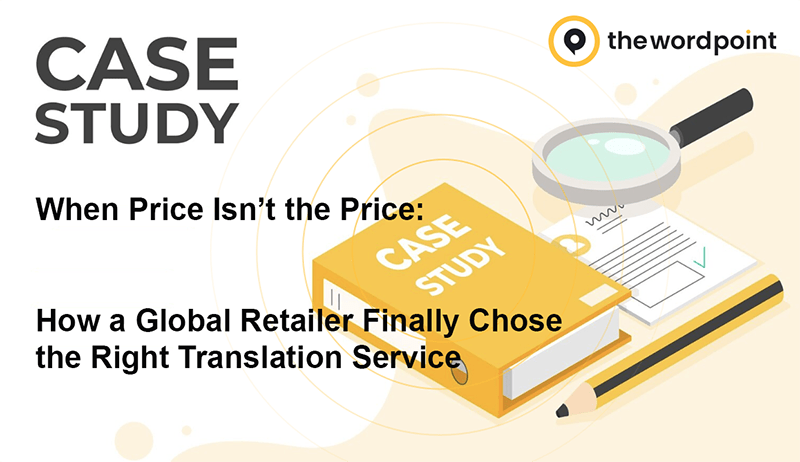
When Price Isn’t the Price: How a Global Retailer Finally Chose the Right Translation Service |
|
Authored by |
|
|
Date |
December 18, 2025 |
|
Industry |
Retail & E-commerce |
Context and backgroundThe client was a fast-growing retail company operating an international e-commerce platform, preparing for a phased expansion into Southeast Asian markets. Their catalog included tens of thousands of SKUs, with new products added weekly and seasonal updates affecting descriptions, attributes, and promotional content. Translation had already become a recurring operational task rather than a one-time project. Internally, translation was viewed as a controllable cost line. Procurement was instructed to secure the lowest possible per-word rate to keep expansion budgets predictable. Several translation service providers were shortlisted based primarily on price and location, with limited consideration for technical integration or scalability. At the time, content updates were managed through a Product Information Management (PIM) system, while translation requests were handled manually via spreadsheets and email. No centralized translation memory existed, and terminology varied across categories and markets. |
|
Challenge
• Inconsistent terminology in different markets and product categories • Repeated translation of identical or near-identical content • Delays caused by manual file handling • Errors introduced during frequent content updates • Increasing internal QA workload • Growing frustration from regional marketing teams Weekly product launches magnified these problems. Each update triggered a new translation cycle, often involving previously translated content. Because no translation memory or automation was in place, the company paid repeatedly for the same work. What looked affordable on paper while looking for the best translation service online, was becoming expensive in practice. Translation costs were rising quarter over quarter, while time-to-market slowed and internal confidence in localized content declined |
|
Approach & SolutionThe turning point came when TheWordPoint helped the Customer to reframe the question. Instead of asking “What online translation service offers the lowest rate?”, the Customer asked “Which translation service can support our operating model with cost-effective solutions?” A professional translation service was selected based on three criteria: System Integration Capability Ability to integrate directly with the client’s PIM system. This removed manual file preparation and enabled automated content handoff between systems. Translation Memory and Terminology Management A centralized translation memory was created from legacy content, capturing previously translated descriptions, attributes, and category language. A controlled terminology base was established for product names, materials, sizing conventions, and compliance-related phrasing. Workflow Designed for Volatility Instead of treating each update as a new project, the provider implemented a continuous localization workflow. Small weekly changes flowed automatically through the CAT tool, triggering translation only for genuinely new content. From a technology standpoint, the approach combined CAT tools, PIM integration, automated QA checks, and human review focused on brand tone and cultural relevance. No machine translation was used initially, the priority was stabilizing quality and eliminating duplication. |
|
ResultsWithin the first two quarters after implementation, measurable improvements emerged: • Translation memory reuse rates exceeded 60% for recurring content • Average turnaround time for weekly updates dropped at 25-30% • Internal QA workload was reduced as consistency improved • Terminology disputes between regional teams declined • Overall translation spend decreased organically, without rate renegotiation Most importantly, cost predictability improved. Instead of facing volatile monthly invoices tied to volume spikes, the retailer gained a stable translation cost curve aligned with actual content growth. |
|
Conclusion & Lesson learnedWhat began as a cost-reduction initiative revealed a deeper understanding og translation procurement. By focusing on workflow optimization rather than unit pricing, the Customer achieved both better quality and lower total spending. Sometimes paying more per word means spending less overall, when you're paying for value, not volume. • Choosing a translation partner who understands your content lifecycle |
|
Important Business Queries Covered In The Case Study
| Best professional translation service for business documents | Affordable business document translation with high accuracy |
| Top-rated online translation services for companies | Reliable human translation services for corporate documents |
| Professional translation agency vs AI translation for business | How to choose the best translation service for business documents |
| Cheap vs professional translation services for companies | High-quality translation services at competitive prices |
| What is the best translation service online | Best value translation service for business use |
Get a Free Quote or Learn About Solutions for Your Business Translation Project
Contact Account Manager

Business Document Translation Services Rates
|
Type of Document |
Human Translation |
Machine Translation Post-Editing |
|
Request for Proposal Translation |
$0.10 |
$0.07 |
|
Employee Handbook Spanish Translation |
$0.10 |
$0.07 |
|
Contract Translation Services |
$0.11 |
$0.07 |
|
Financial Statements |
$0.11 |
$0.08 |
|
Business Proposal Translation |
$0.11 |
$0.08 |
|
Company Policies |
$0.11 |
$0.07 |
|
Employee Contracts |
$0.11 |
$0.07 |
|
E-Commerce Content |
$0.09 |
$0.06 |
Meet Our Customers














.png)
.png)
What They Say About Us
.png)
2 reviews
"I've used TheWordPoint for a number of translation projects for a legal information website and always been very happy with them. They are easy to work with and do an excellent job."
FAQ
Should a business choose the cheapest translation quote?
Not necessarily. The lowest price often indicates compromises in quality, experience, or process. Poor translation can cost more long-term through. Evaluate quotes based on translator qualifications, QA processes, agency reputation, and what's included, not just price alone. The middle-range quote often offers the best value.
What's included in the translation price?
Standard translation pricing typically includes translation by a qualified native speaker, basic proofreading or editing, project coordination, standard file formats (Word, Excel, plain text), and one round of revisions based on accuracy concerns. It generally excludes desktop publishing, rush delivery, certification, multiple revision rounds due to source content changes, and highly specialized formatting.
How can a company reduce translation costs without sacrificing quality?
Price Effective Strategies include planning projects in advance to avoid rush fees, providing reference materials and glossaries, writing clear, simple source content, leveraging translation memory for recurring content, consolidating projects to benefit from volume discounts, choosing the right service level (not all content needs premium translation), maintaining long-term agency relationships for better rates, and investing in a translation management system for ongoing needs.
Is machine translation cheaper, and should a business use it?
Machine translation is significantly cheaper (often $0.01-0.03 per word with post-editing) but appropriate only for specific use cases: high-volume, low-stakes content, internal documents, or content requiring only "gist" understanding. It's unsuitable for marketing materials, legal documents, customer-facing content, or anything requiring cultural nuance. Poor machine translation can damage brand reputation and customer trust.
What factors influence the cost of translation?
Key factors include: language pair rarity, content complexity and specialization, volume of text, deadline urgency, file format complexity, whether certification is required, need for desktop publishing or formatting, translation memory leverage from previous projects, and whether the content requires cultural adaptation (transcreation) versus literal translation.
How does translation memory reduce costs?
Translation memory (TM) stores previously translated content in a database. When translating updated documents, the system identifies matching or similar segments, which require less translator effort. Agencies typically offer discounts of 30-75% for high matches and 100% matches from TM, making updates and recurring content translation more economical.
Why do translation prices vary so much between translation companies?
Price differences reflect variations in translator expertise, quality assurance processes, technology use, and business overhead. Lower prices may indicate machine translation with minimal editing, less experienced translators, or no review process. Higher prices typically include native-speaker translators with subject matter expertise, multi-stage quality checks, and project management support.
Can’t find an answer to your questions? Feel free to check our complete FAQ page, or contact us at [email protected]
Are you ready to start?
Translate Now
Our Support is available round the clock to make sure that the working process is smooth and comfortable.